Scan-to-BIM · Practice
The real ROI of Scan-to-BIM on renovation projects
Published 2026-04-08 · By the 3DExperts team
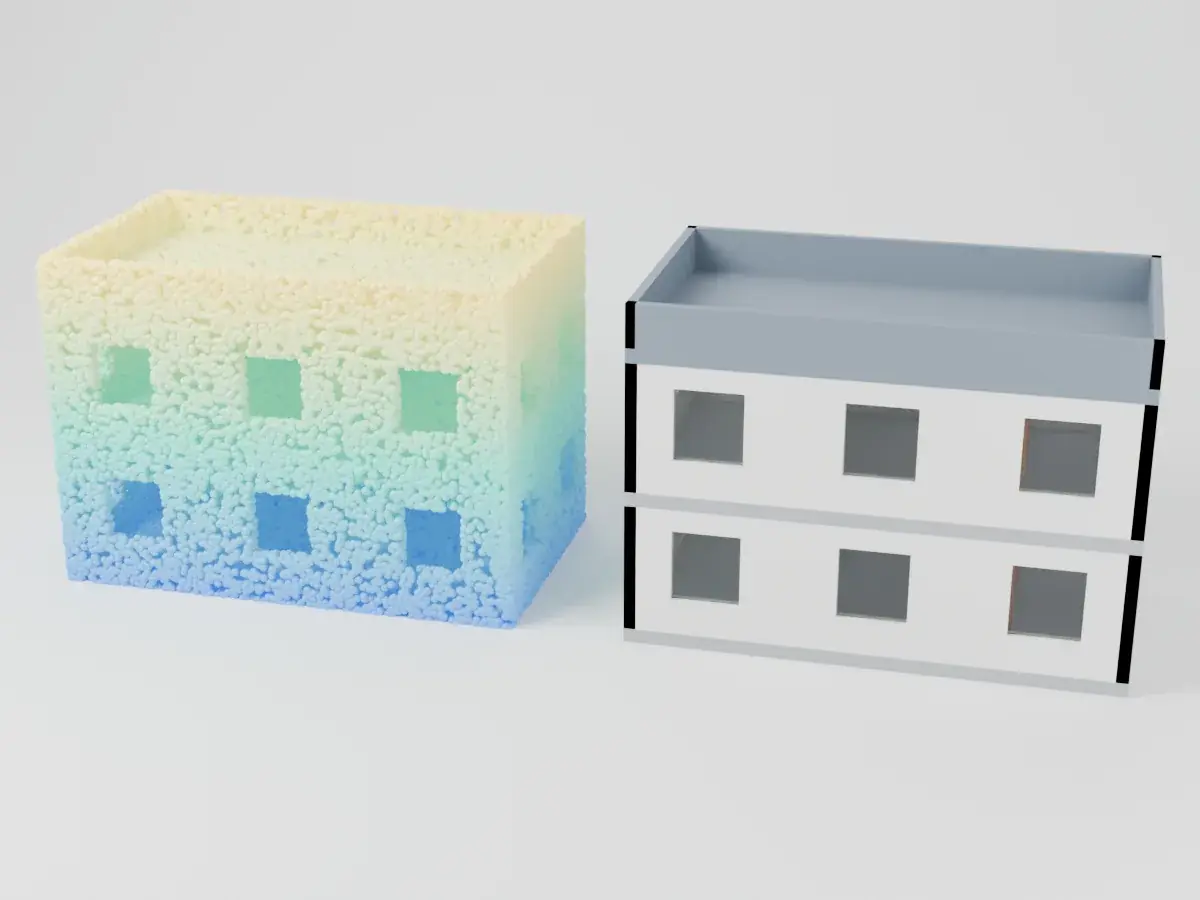
Clients almost always ask the same question in the first scoping call: "Is Scan-to-BIM worth it for a renovation?" The honest answer is: yes, and the math is less complicated than most people think.
Where the money actually goes on a renovation
On a mid-sized adaptive-reuse project (2,000–10,000 m²), the costs that hurt the most are almost never the original design fee. They are:
- Rework during construction — a wall is 8 cm thicker than the drawings said, so the new MEP routing clashes and has to be redone.
- Change orders — unexpected conditions found on site turn into contractor markup.
- Schedule slippage — every week of delay has a fixed overhead cost that clients underestimate.
- Disputes — arguments about "whose mistake this is" that consume management time and sometimes lawyers.
A conservative cost model
Take a 3,000 m² office conversion. Assume Scan-to-BIM at LOD 300 for this size costs €12,000–€18,000 — an assumption for this example, not a quote. Not a small number in isolation.
Now compare with what usually happens without accurate as-built data:
- 2–4 rework events during construction: €15,000–€40,000
- 1–2 change orders from unknown site conditions: €10,000–€30,000
- 1–3 weeks of schedule slippage on a multi-million euro project: €20,000–€80,000 in overhead and financing
Total avoided cost (conservative): €45,000–€150,000. Scan-to-BIM investment: €12,000–€18,000. The ratio is usually 3–8x.
The firms that commission Scan-to-BIM early almost never regret it. The firms that skip it almost always regret it — quietly, in the form of "we should have done this from the start".
When Scan-to-BIM does NOT pay off
Honesty matters. There are cases where it is overkill:
- New-build on a clean greenfield site — there is nothing to scan.
- Projects where original drawings are very recent and very accurate (rare, but it happens).
- Very small interventions (a new partition wall in a single room) where the cost of scanning exceeds the cost of manual measurement.
For everything else — and especially for commercial, hospitality, and institutional retrofits at scale — Scan-to-BIM is the single highest-ROI decision you make in the pre-design phase.
Practical next steps
If you are evaluating a renovation project right now, three questions to ask before committing:
- How old are the existing drawings, and by whom were they produced? If they are more than 10 years old or contractor-produced, expect inaccuracies.
- What is the MEP density? High-density MEP (hospitals, labs, data centers) dramatically increases the ROI of accurate as-built data.
- What is the penalty per week of schedule slippage? This number is almost always larger than the Scan-to-BIM fee.
Want a concrete quote for your specific project? Book a 30-minute scoping call — we will give you a range based on size, LOD, and access conditions, with no commitment.