How it works · 3D Printing
Metal SLM prototype series — how it runs
Published 2026-04-08
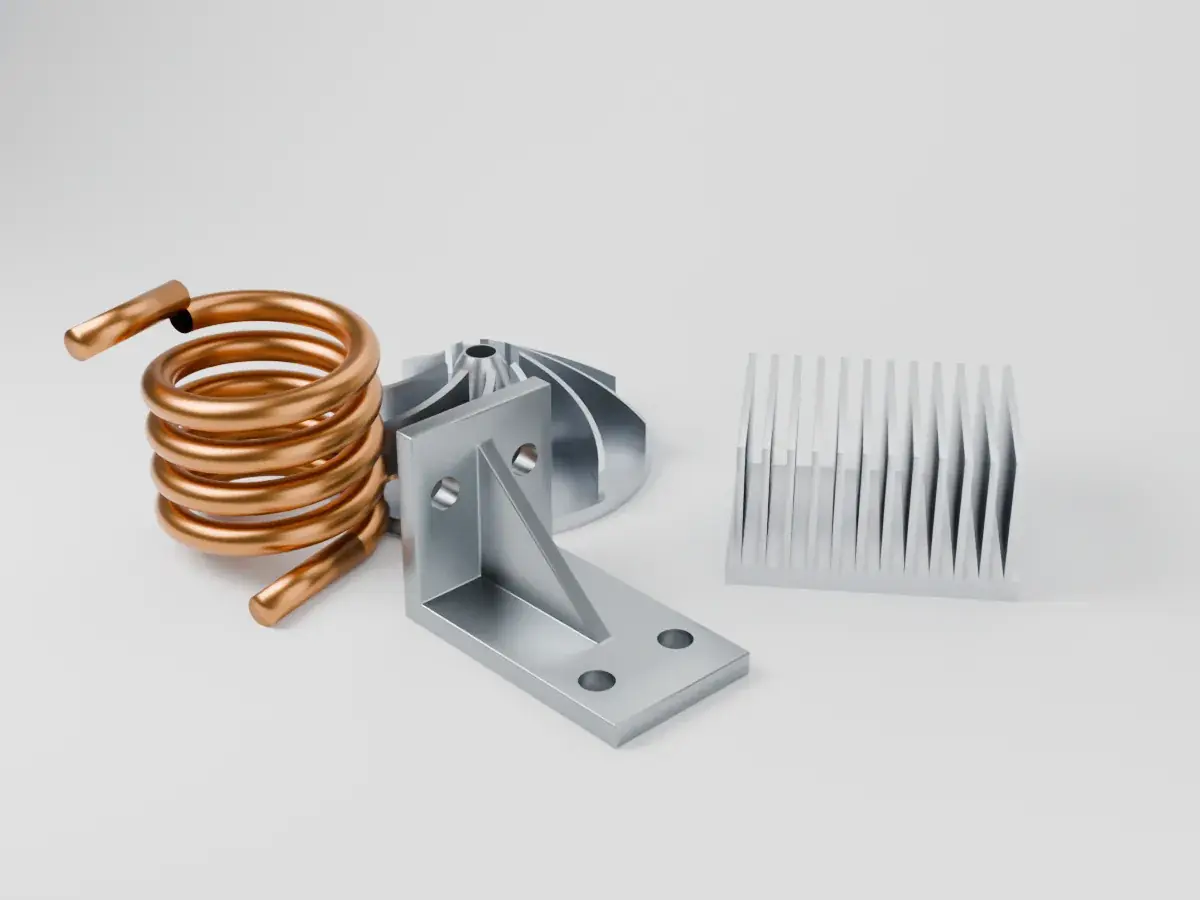
A typical brief
An engineering team needs a small series of structural aluminium parts to validate a mechanical assembly before committing to tooled production. The geometry includes internal channels that CNC machining alone cannot reproduce, and there is a testing window to hit.
When metal printing is the right choice
Three factors point away from traditional manufacturing and toward Selective Laser Melting (SLM):
- Internal channels — integrated fluid passages that cross through the part body. Impossible to machine without splitting and rejoining, which would have compromised structural integrity.
- Geometry complexity — organic, load-optimized shape that was designed for additive manufacturing from the start.
- Low quantity, high value per part — at a handful of parts, tooling costs more than the parts themselves.
Process
- DfAM review — a call to review the CAD and flag geometry that fights the process (overhangs, thin walls, support-trapped cavities), with suggested adjustments.
- Material selection — AlSi10Mg (aluminum-silicon alloy) for the combination of strength, weight, and post-T6 heat treatability.
- Build — parts printed by our partner in a single build with support structures optimized for minimal post-processing.
- Post-processing — support removal, stress relief, T6 heat treatment, bead blasting, and a dimensional inspection report.
- Handover — finished parts shipped with an inspection report against the CAD model.
What to expect
- 10–20 working days of production from order confirmation, plus shipping. The quote states the exact date.
- An inspection report against your CAD with the delivered parts.
- One point of contact from DfAM review to delivery.
Key takeaways for engineers evaluating metal 3D printing
- Metal printing is not a replacement for machining — it is a complement. Pick it when geometry demands it or when lead time and low quantity make tooling uneconomical.
- Design for AM early. Parts designed for subtractive methods and converted later rarely perform well. The best results come from geometry conceived for the process.
- Post-processing matters. Heat treatment and surface finish can change mechanical properties significantly. Plan them into the spec from the start.
- Budget for QA. A dimensional inspection report is not a luxury — it is how you know the part you are testing matches the digital design.
Have a similar project?
We offer a free 30-minute DfAM review for any metal 3D printing project. We will look at your geometry, flag potential issues before you commit, and give you a realistic budget and lead time range.
Get in touch or read more on the 3D printing service page.